
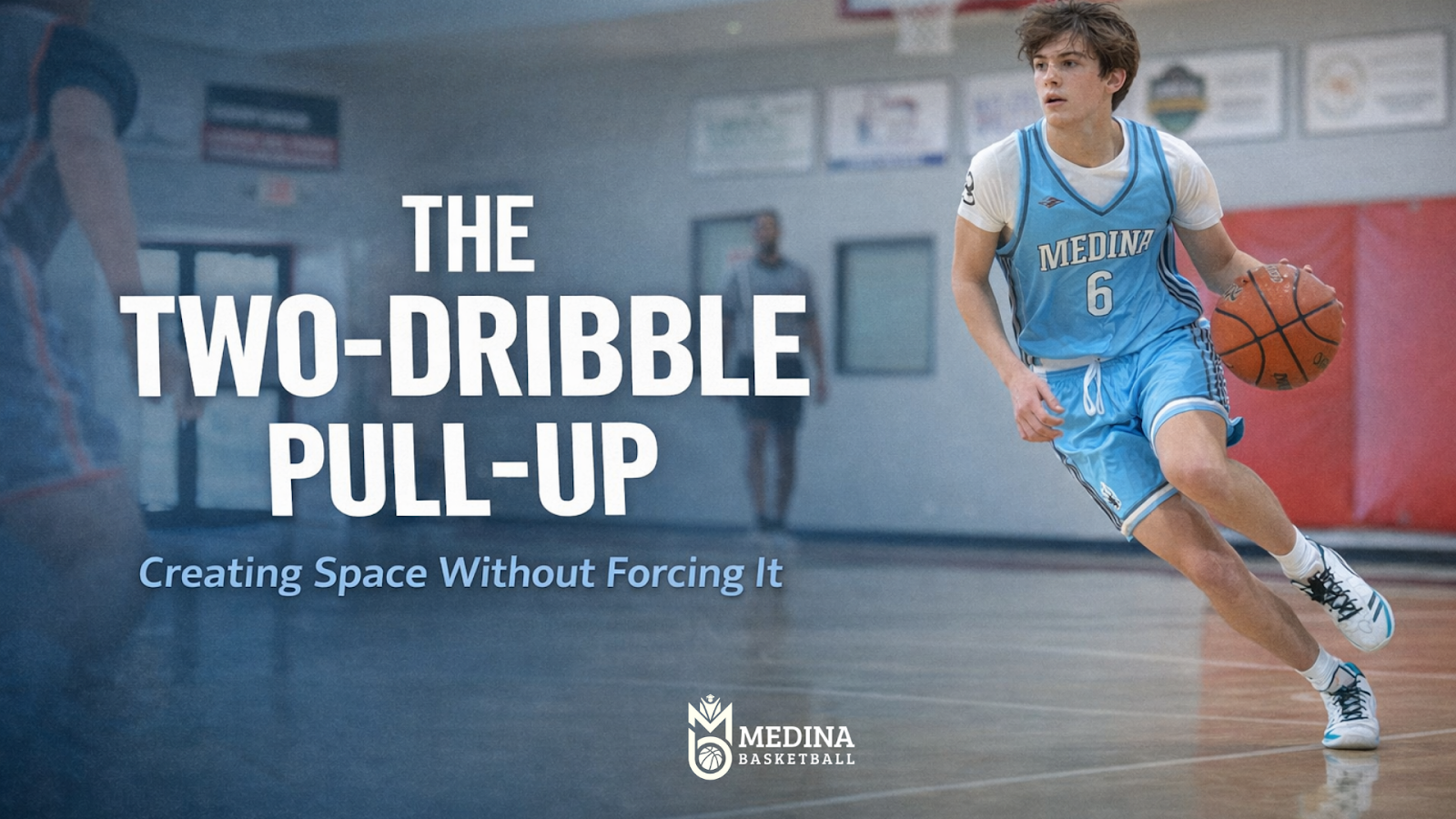
Why One Dribble Isn’t Always Enough
At younger levels, players are taught to attack quickly — and that’s not wrong.
But as competition improves, defenders recover faster and help defense shows up earlier. One dribble often isn’t enough to create real separation anymore.
That’s where the second dribble changes everything.
The two-dribble pull-up allows players to:
- Move defenders out of position
- Cover more space without speeding up
- Stop and shoot where help can’t reach
NBA tracking data consistently shows that shots taken after a controlled relocation are more efficient than shots taken while drifting or fading. The body shoots better when it’s allowed to stop on balance.
That’s not a confidence issue — it’s physics.
What Parents See (Even If They Don’t Know the Name)
When this skill isn’t trained, parents often notice:
- Players driving straight into crowds
- Forced floaters or contested layups
- Shooters who pass up open pull-ups because they feel rushed
When it is trained, the difference is obvious:
- Players stop suddenly in space
- Defenders fly by just a step too late
- Shots look calm, even late in the clock
The player didn’t get lucky.
They used space intelligently.
Reading the Defender: The Hidden Skill
The two-dribble pull-up isn’t just about taking extra dribbles.
It’s about reading what the defender is doing.
After the first dribble, the player is already processing:
- Is the defender sliding?
- Are they backing up?
- Is help stepping up?
That second dribble becomes a tool — not a habit.
Elite scorers don’t dribble more.
They dribble with purpose.
This is why high-level guards look patient without being passive. They’re buying time to let the defense reveal itself.
Same Direction, Smarter Attack
One of the most effective (and safest) versions of this shot is attacking in the same direction.
Why?
Because changing direction too early can invite help.
Staying on one line allows the player to:
- Push the defender backward
- Maintain momentum
- Stop suddenly before help arrives
Instead of driving at the rim, the player relocates away from congestion.
From the wing or top of the key, two controlled dribbles can flip the floor — turning a crowded paint into an open mid-range window.
That’s a veteran move, taught early.
Why This Matters in AAU Basketball
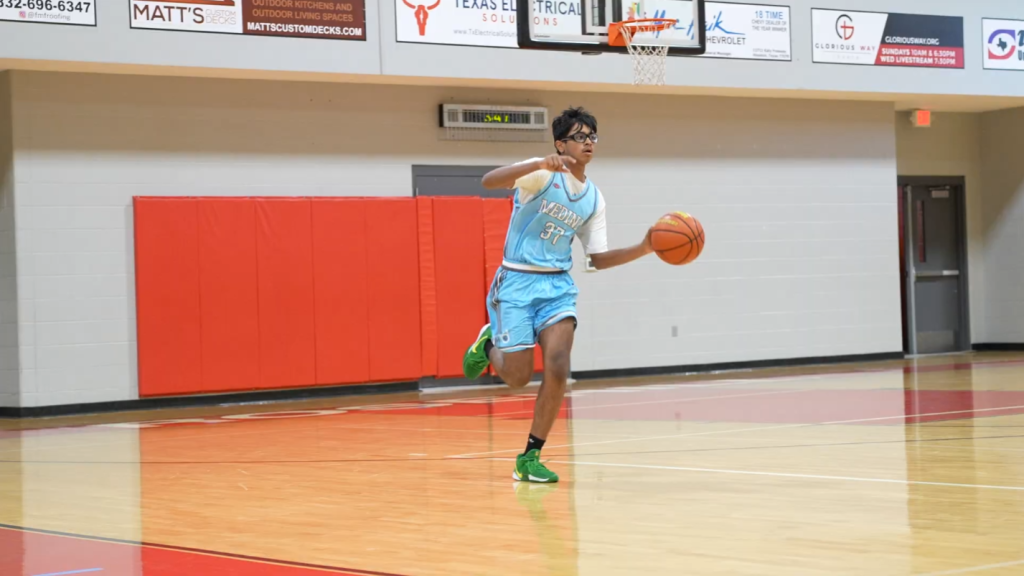
AAU games are fast, spaced, and aggressive.
Help defense is early.
Closeouts are hard.
Shots disappear quickly.
Players who rely on speed alone often look rushed.
Players who understand space look composed.
The two-dribble pull-up gives players a way to:
- Slow the game down without stopping it
- Stay aggressive without forcing plays
- Score without needing the perfect lane
That’s why coaches value it so highly — especially for guards and wings.
The Bigger Development Picture
This lesson isn’t about taking more shots.
It’s about teaching players when not to force one.
When players learn how to use two dribbles to relocate:
- Decision-making improves
- Shot selection cleans up
- Confidence becomes grounded, not emotional
The game starts to feel simpler.
And that’s usually when growth accelerates.